11th December 2025
Australia has just made global history.
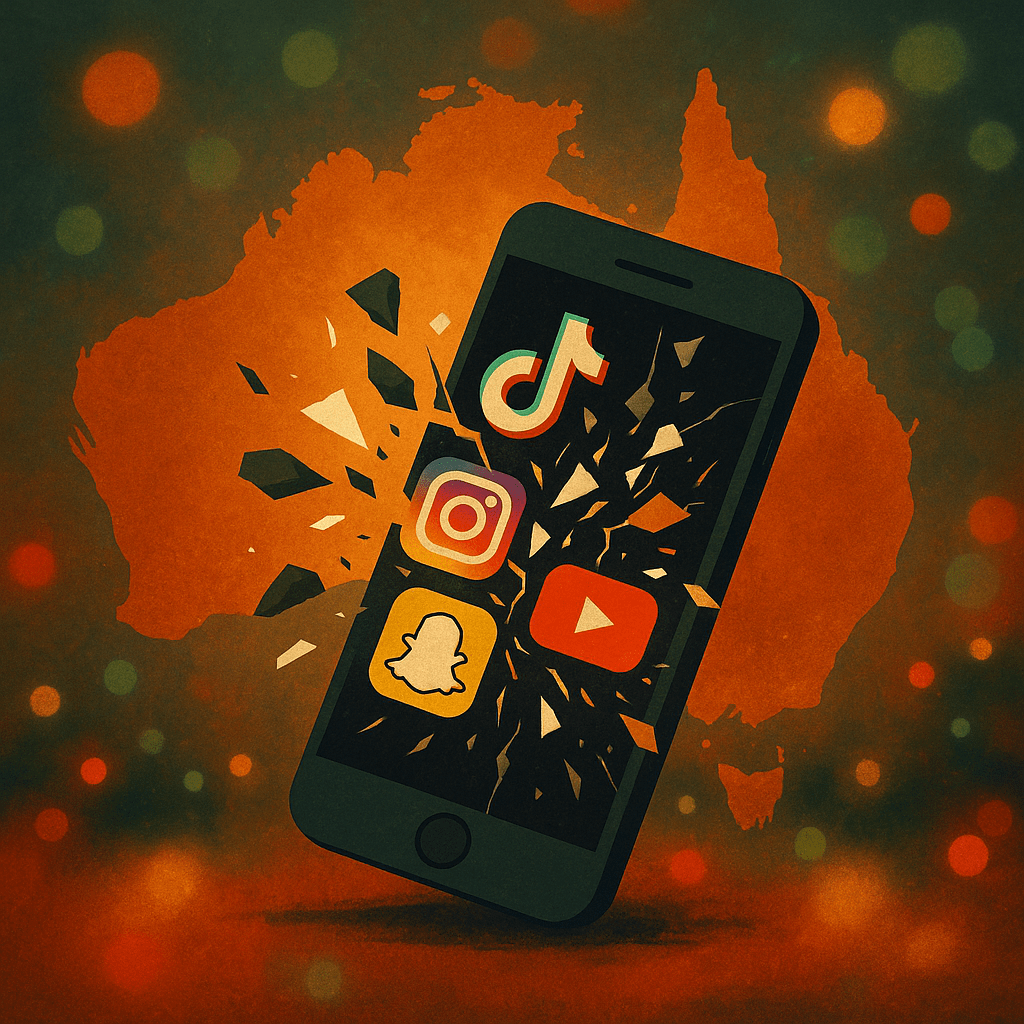
They’ve become the first country to ban under-16s from using social media. No TikTok. No Instagram. No Snapchat. No YouTube. No Facebook. Not restriction. Not moderation. Full removal.
Tens of thousands of accounts are already gone. It happened fast. Quietly. Then suddenly it was everywhere. Teenagers are calling it “the end.” Parents are scrambling. Clinicians are watching the fallout build before it breaks.
This isn’t just a tech ban. It’s a nervous system event.
Social media is wired into regulation. For most teens, it’s not a hobby — it’s how they slow down. When the room’s too loud. When the house feels off. When the body’s carrying more than it can name — they scroll. They connect. They distract. They breathe.
Swipe. Stimulus. Response. Relief. That’s the loop. It becomes rhythm. Remove the rhythm and the system stutters. Remove it overnight and it crashes.
This ban triggers withdrawal. Not metaphorically. Literally. Dopamine drop. Mood swings. Sleep disruption. Emotional volatility. It won’t look dramatic, but it will be deep. For the sensitive, the fast-processing, the emotionally overloaded — the hit lands harder.
Most teens won’t say, “I’m struggling.” They’ll just argue. Shut down. Go silent. Act out. The body carries what the mouth can’t say.
Parents are now on the frontline of something they didn’t ask for. They weren’t briefed. They didn’t opt in. But they’ll be the ones absorbing the backlash.
There’ll be conflict. Disconnection. Confusion. Some will lean in and get it wrong. Some will pull away and regret it later. Some will realise — too late — that what their child lost wasn’t entertainment. It was their only outlet.
And it’s happening in December.
Christmas already tests emotional capacity. Routines collapse. Grief resurfaces. Pressure builds. Everything gets louder.
Social media — for all its faults — has been a buffer. A place to disappear for a moment. To feel seen by someone, even if it’s just a stranger’s post.
Take that away now and the emotional load gets heavier. Claustrophobia builds. No release. No distraction. Just proximity, comparison, demand — and no tools to handle it.
This is where it connects to what I wrote on 9 December.
In “Why Chatbots Can’t Heal Trauma”, I responded to a Guardian piece that reported one in four teenagers now turn to AI for mental health support.
Not teachers. Not parents. Not peers. AI.
Chatbots like Replika, Snapchat AI, and the rest are becoming the “safe space.” Because they’re always on. Never confrontational. No risk. No shame.
But I said then — and I’ll say it again — digital presence is not human attunement.
Chatbots don’t see a shutdown. They don’t sense fear. They don’t pause when someone’s voice falters. They don’t say, “I’m here. I’ve got you.”
They’re available. But they don’t hold.
Now take that AI coping tool — already thin — and pair it with this week’s ban. We’ve now cut off both: the bot and the broader network.
What’s left?
Silence.
For many young people, this week has stripped away everything they used to feel safe. Even if it was only an illusion — it still functioned.
And that’s the part we can’t ignore.
Digital tools — AI companions, social feeds, passive connection — have been filling the vacuum. Not because they’re ideal, but because they’re accessible.
The deeper issue isn’t that teens turned to tech. It’s that they had nowhere else to turn.
This ban didn’t create the crisis. It exposed it.
Some will react with resistance. Others with grief. Others with nothing at all — the flat-line that signals collapse. Some will find workarounds. Darker corners. Hidden apps. Unregulated alternatives.
Others will just disappear inward.
Because the scroll reflex doesn’t vanish. It rebounds.
Australia made a bold move. And yes — something had to change. The damage these platforms cause is real. Constant stimulation, comparison loops, self-image distortion, grooming risks. It needed facing.
But timing matters. Replacement matters. Co-regulation matters.
You can’t ban the substitute without offering the substance.
And right now, the substance is missing.
This is bigger than the ban.
It’s about what young people are now being forced to face — without tools, without support, and without the very systems that failed to hold them before the apps took over.
We’ve pulled away the crutch. That’s fine.
But we’ve forgotten the leg was still broken.
This is a call, not a critique.
Parents need backup.
Schools need a plan.
Clinicians need to be ready.
Governments need to stop pretending policies are enough.
This isn’t about apps.
It’s about connection.
And the absence of it — at scale — always creates fallout.
Final word.
You can’t delete the lifeline and call it healing.
You have to replace it.
With presence. With steadiness. With people who stay when the body starts to shut down.
Otherwise, all you’ve done is confirm what many teens already fear: No one’s coming.
Reuters — “This is the end”: Australian teens mourn social media ban (10 Dec 2025)
https://www.reuters.com/world/asia-pacific/this-is-end-australian-teens-mourn-loss-social-media-ban-begins-2025-12-10/
The Guardian — Inside the 12 December social media ban (10 Dec 2025)
https://www.theguardian.com/news/2025/dec/10/australias-social-media-ban-inside-the-12-december-guardian-weekly
Why Chatbots Can’t Heal Trauma — My blog (9 Dec 2025)
https://rogerhughes.org/2025/12/09/why-chatbots-cant-heal-trauma/
More ways to find me:
TherapyCounselling.org – Online EMDR Therapy UK
Counselling.Network – Roger Hughes


Leave a reply to What Happens to a Teenager’s Brain When Social Media Stops Overnight – Online EMDR Therapy UK | Accredited Trauma-Informed Therapist – Roger Hughes Cancel reply