By Roger Hughes | EMDR & Trauma-Informed Coach | UK-wide
15th December 2025
Thank you for being here. If something in this article resonates with you and you’d like to talk, you’re very welcome to get in touch. You can also browse other articles or return to the homepage if you’d like to explore more. And if you’d like to leave a comment or suggest a future topic, I’d genuinely love to hear from you. Now, on to the article.
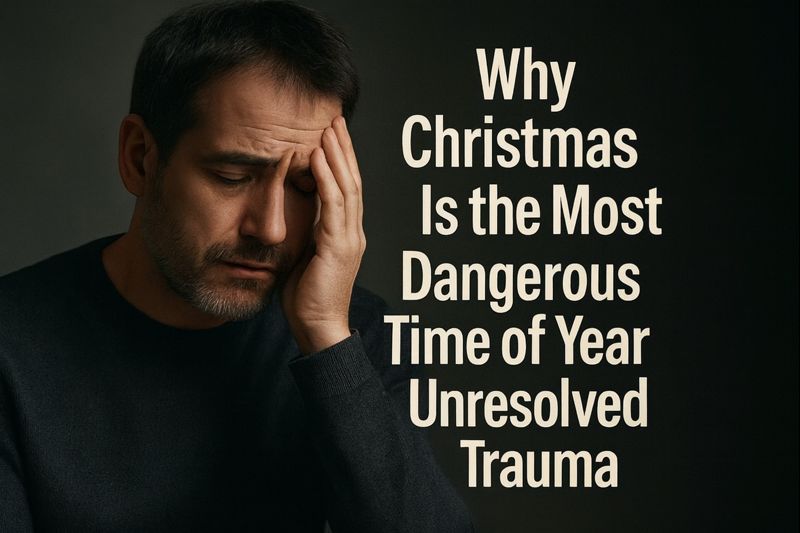
Christmas does not break people. It reveals what has been held together.
For most of the year, life provides structure. Work schedules, routines, obligations, and momentum keep people moving forward. For many individuals living with unresolved trauma, this structure is not incidental — it is regulatory. It keeps the nervous system organised, focused outward, and contained.
When Christmas arrives, that structure loosens. Work slows or stops. Expectations shift from doing to being. The noise reduces. And when the noise drops, unresolved trauma often becomes more noticeable.
This is not a personal failure. It is a predictable nervous-system response.
Trauma is not stored as a story
A common experience at Christmas is confusion. People say, “Nothing bad is happening, so why do I feel like this?” The answer lies in how trauma is stored and expressed.
Psychological trauma is not primarily held as conscious memory. Research shows it is encoded in the body and nervous system — through physiological responses, emotional patterns, and implicit memory rather than narrative recall. This means the brain may understand that the present is safe, while the body responds as if an earlier threat is still active.
Christmas is saturated with cues that activate implicit memory. Sounds, smells, family environments, rituals, and interpersonal dynamics can all trigger bodily responses without conscious awareness. The reaction often precedes thought: tension, withdrawal, irritability, emotional numbness, or sudden sadness with no obvious cause.
These reactions are not random. They are the nervous system recognising patterns it learned long ago.
Why people cope all year and struggle in December
Many people with unresolved trauma function well in daily life. They are reliable, capable, and often high-performing. This is not because trauma has disappeared, but because adaptation has occurred.
Trauma often teaches people to stay alert, responsible, and self-contained. Predictability becomes safety. Staying busy becomes regulation. Structure helps keep overwhelming sensations at bay.
For most of the year, this strategy works.
Christmas disrupts it. The loss of routine and the increase in emotional expectation remove the external scaffolding that kept the system organised. The nervous system, no longer anchored by constant demands, has space to register what has been deferred.
Mental health charities and NHS services consistently note that emotional distress increases during the festive period, particularly among people with existing mental health difficulties or trauma histories. The season does not create these difficulties — it exposes them.
Why distress can increase when life is stable
One of the least understood aspects of trauma recovery is that symptoms often intensify when life becomes calmer.
When life is chaotic, the nervous system remains mobilised. It stays in survival mode, focused on immediate demands. When life stabilises, the system begins to downshift. That is often when previously unprocessed material surfaces.
Christmas accelerates this process. It is one of the few periods where stopping is culturally enforced. Reflection is encouraged. Stillness is expected. For a nervous system shaped by threat, this can feel deeply uncomfortable.
This pattern is well recognised in trauma research. Symptom emergence during periods of safety is not regression — it is often a sign that the system finally has capacity to process what it could not before.
The real risk: self-judgement
The most damaging aspect of Christmas distress is not the feeling itself. It is how people interpret it.
Rather than understanding their reaction as a trauma-based response, many people turn inward with criticism. They conclude they are ungrateful, broken, or failing at something that seems easy for others. This misinterpretation increases shame and reinforces suppression.
Research shows that self-criticism and avoidance worsen trauma-related symptoms, while understanding and regulation reduce them.
In an attempt to cope, people often rely on alcohol, over-activity, or emotional numbing. These strategies may provide short-term relief, but they do not resolve the underlying nervous-system activation.
Trauma does not always look dramatic
Unresolved trauma often presents quietly.
Withdrawal instead of collapse.
Numbness instead of sadness.
Irritability instead of fear.
At Christmas, when warmth and connection are expected, this contrast can feel particularly stark.
NHS data and winter briefings consistently report increased presentations related to loneliness, emotional distress, and overwhelm during the festive period — even among people who appear outwardly stable.
Family, roles, and the return of the past
Christmas is one of the few times adults are routinely pulled back into family systems that shaped them. Old roles often re-emerge without intention. Tone, hierarchy, and expectation return quickly.
For individuals with unresolved trauma rooted in early relationships, this can be deeply activating. Even when nothing overtly negative happens, the body recognises familiar dynamics and responds accordingly.
Family-related stress is repeatedly identified as a major contributor to Christmas-related distress in UK surveys.
What recovery actually involves
Recovery from trauma is not about forcing enjoyment or reframing Christmas as something it is not.
It is about regulation.
Understanding.
Choice.
It involves learning to notice bodily responses without judgement, separating past threat from present reality, and reducing self-blame.
For some people, Christmas becomes easier.
For others, it becomes neutral.
Both are signs of healing.
A steadier way forward
If Christmas is difficult for you, it does not mean you are broken.
It often means you adapted early to survive — and those adaptations are still active.
Unresolved trauma waits for quiet moments.
Christmas provides them.
Understanding this, without judgement or pressure to perform, is often where real recovery begins.
Not cheer.
Not performance.
But steadiness.
References
The Body Keeps The Score | Bessel van der Kolk, MD.
Trauma and Recovery by Judith Lewis Herman | Open Library
Christmas and mental health | Information and support | Mind
Leave a Reply