By Roger Hughes | EMDR Therapist & Trauma-Informed Life Coach
31st December 2025
Thank you for being here. If something in this article resonates with you and you’d like to talk, you’re very welcome to get in touch. You can also browse other articles or return to the homepage if you’d like to explore more. And if you’d like to leave a comment or suggest a future topic, I’d genuinely love to hear from you. Now, on to the article.
The Quiet Weight of Survival
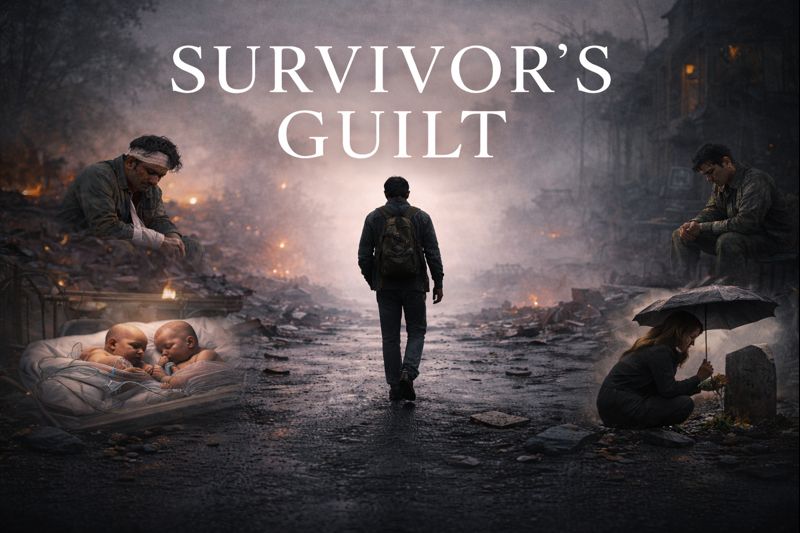
Survivor’s guilt doesn’t always come with loud emotion. Often, it arrives in silence. You’re still here, but someone else isn’t. And even if you had no control over what happened, something inside you can’t let it go. That’s the quiet weight many people carry after trauma, not just the event itself, but the burden of making it through when others didn’t. This piece is about that weight. It’s about what it means to survive. Not just physically, but emotionally. What happens when the world calls you lucky, but inside you don’t feel lucky at all. When living itself starts to feel like a betrayal. And when the question “Why me?” becomes a loop that won’t stop running.
A Real-World Example: Survival After Catastrophe
In June 2025, Air India Flight AI171 crashed seconds after takeoff, killing over 260 people including passengers, crew, and those on the ground. Only one person survived: a man named Viswash Kumar Ramesh. He didn’t climb out of the wreckage unscathed. He lost his younger brother. He suffered major injuries. He saw the faces of the dying. And when he walked away, he didn’t walk into peace. He walked into trauma. Into the kind of silence that survivor’s guilt creates. That kind of survival isn’t something you bounce back from. It isn’t something you explain with gratitude. It’s something that reshapes how you see yourself, the world, and your place in it. For Ramesh, surviving wasn’t the end of the crisis. It was the beginning of something he hadn’t expected: emotional collapse, disconnection from his family, and the haunting presence of guilt. He described himself as the luckiest man alive, and also the most broken. That contradiction sits at the heart of survivor’s guilt.
What Survivor’s Guilt Actually Is
So what exactly is survivor’s guilt? It’s not just feeling bad that something terrible happened. It’s the specific psychological, emotional, and physical reaction to surviving something that others didn’t. Whether it’s a plane crash, a war zone, a suicide, a childhood home that wasn’t safe, or a family where one sibling got rescued and another didn’t, the feeling is the same. You made it. Someone else didn’t. And now you can’t shake the belief that somehow, that matters. Not just emotionally. Morally. As if your survival has to be justified, earned, or atoned for. Survivor’s guilt shows up when the mind tries to do emotional maths it can’t solve. It happens when the nervous system screams for logic in a situation that has none. When we lose people and we’re still here, we look for a reason. But in trauma, reason rarely exists. So we create it. And guilt, strange as it sounds, becomes a way to give meaning to the meaningless.
How Survivor’s Guilt Lives in the Body
This guilt isn’t abstract. It lives in the body. Survivor’s guilt is rooted in the nervous system, the same system that goes into overdrive when you’re in danger. When something traumatic happens, the body responds immediately. Heart rate spikes. Breathing shifts. Time warps. Emotions get suppressed. Your body chooses survival. And for many people, that works. They live. But afterward, when the danger is over, the system doesn’t always reset. It scans the environment and realises someone else didn’t make it. That’s when the guilt lands. And not just as a thought, but as a physiological pattern: sleepless nights, shame without cause, a flatness you can’t explain, a sense of disconnection from joy, or a discomfort in your own skin. You might smile on the outside while quietly feeling you don’t deserve the life you’re living. This is what happens when the nervous system tries to restore balance to an imbalanced outcome. Guilt becomes the way the body tries to make the world fair again. It’s a desperate attempt to restore order.
Where Survivor’s Guilt Begins: The Earliest Roots
When we start at the very beginning, before memory, before language, before conscious thought, one of the clearest places to understand survivor’s guilt is in twins who are separated. This is not because twins are “special cases,” but because they show us something fundamental about how the human nervous system understands connection and loss. In the womb, twins develop in constant relationship. Their bodies grow side by side. Their rhythms sync. Their nervous systems calibrate around another presence. Safety, regulation, and identity form in relation to that shared existence. When that bond is broken, through adoption, medical separation, death, or removal, the split happens before the brain can make meaning of it. There is no story yet, no words, no explanation. But the body registers absence. The body registers rupture. One presence is suddenly gone, and the system must reorganise itself around that absence.
When One Twin Is Kept and the Other Is Lost
When one twin is kept and the other is given away, the surviving twin often grows up with an unnameable sense that something is missing. Not in a dramatic or obvious way, but as a quiet undertone running through life. They may feel different without knowing why. They may carry a persistent sense of responsibility, or a low-level guilt that has no clear source. They may struggle with closeness or feel hyper‑attuned to others’ emotions. They may feel driven to be “good,” to behave, to succeed, to justify their place. None of this comes from conscious memory. It comes from early nervous system learning. The body learned that connection can disappear. It learned that survival is uneven. And because no one helped translate that loss into meaning, the system internalised it as something personal.
Survivor’s Guilt Before Language Exists
This is survivor’s guilt at its earliest and most invisible level. It isn’t formed through conscious thought. It’s formed through biology. Through attachment. Through the simple fact that the nervous system encodes safety and threat long before language develops. When one twin remains and the other is gone, the surviving child does not think, “My twin was taken.” Instead, the body absorbs a more primitive message: “Something was lost, and I’m still here.” Over time, that can quietly turn into, “Why am I here?” or “I must make myself worthy of being here.” That belief doesn’t announce itself. It hides inside behaviour, relationships, and identity.
How Early Survivor’s Guilt Shapes Adult Life
As life goes on, this early template often shapes how survivor’s guilt shows up later. The person may grow into an adult who takes on too much responsibility, who feels uncomfortable being cared for, or who feels an unspoken obligation to carry emotional weight for others. They may feel guilty when things go well. They may struggle to rest. They may feel uneasy with joy, praise, or success. Not because they are ungrateful, but because some part of their system learned very early that being the one who “stayed” came with a cost. That cost is often paid in silence.
The Same Pattern Across Different Traumas
This same mechanism appears again and again across very different life situations. The details change, but the internal pattern stays remarkably similar. When someone survives a disaster, a crash, a fire, a collapse, their nervous system does something very similar. In the moment of danger, survival takes over. The body does what it must to live. Afterwards, when the threat is gone, the system looks around and notices who didn’t survive. That recognition creates a rupture in meaning. The survivor didn’t choose to live. They simply did. But the mind searches for logic, fairness, or reason. When it can’t find one, guilt steps in to fill the gap.
The Case of the Sole Survivor
This is exactly what we see in the case of Ramesh, the sole survivor of the Air India crash. From the outside, his survival looks extraordinary. Miraculous, even. But internally, survival can feel like an unbearable contradiction. He lived. His brother didn’t. Others didn’t. That imbalance alone is enough to destabilise a person’s inner world. The body doesn’t interpret survival as “luck.” It interprets it as unfinished business. The nervous system asks questions it cannot answer: Why me? Why not them? What does this mean about my right to live? Those questions don’t stay in the head. They sink into the body.
When Survivor’s Guilt and Trauma Intertwine
In cases like this, survivor’s guilt often shows up alongside post‑traumatic stress. Nightmares, withdrawal, hypervigilance, emotional numbing—these are common. But survivor’s guilt adds another layer. It adds moral weight. It adds shame. It creates the feeling that being alive now carries an obligation or a debt. Ramesh’s reported withdrawal, his difficulty reconnecting with family, and his sense of loss are not signs of weakness. They are signs of a nervous system overwhelmed by survival without meaning. When people say things like “he should be grateful,” they misunderstand trauma completely.
Survivor’s Guilt Across Different Lives and Losses
This same pattern appears in many other contexts. Soldiers who return from combat while their friends die often describe feeling like impostors in their own lives. They may feel undeserving of peace or comfort. They may sabotage relationships or avoid happiness. Healthcare workers who lived through COVID often carry guilt for patients they could not save, even when they did everything possible. Parents who lose one child but not another may find themselves torn between love and guilt. People in accidents who survive while others don’t often replay the moment endlessly, searching for a reason. Addiction recovery carries its own version: surviving while friends overdose can leave deep, lasting guilt. In each case, the story changes, but the internal experience remains strikingly similar.
Why the Mind Turns to Guilt
What ties all of these together is not the event itself, but the human need for meaning. Our nervous systems are not built to tolerate randomness well. When something catastrophic happens without a clear cause, the psyche searches for order. Guilt becomes a way to impose logic on chaos. It creates a sense of control, even if that control hurts. If I am to blame, then the world makes sense again. If my suffering balances the scales, then maybe the loss has meaning. This is why survivor’s guilt can be so persistent. It feels morally protective, even when it’s painful.
The Role of Empathy and Moral Sensitivity
Empathy also plays a major role. People who experience survivor’s guilt are often deeply empathic. They feel other people’s pain strongly. That sensitivity, which is usually a strength, turns inward after trauma. Compassion becomes self-punishment. Care becomes self-denial. The very qualities that make someone kind and connected can become the fuel for guilt. When combined with early experiences of having to be “good,” responsible, or emotionally self-sufficient, survivor’s guilt can become a lifelong pattern.
Cultural and Moral Messages That Reinforce Guilt
Cultural and moral frameworks can intensify this further. In many cultures, suffering is tied to virtue. Sacrifice is praised. Endurance is moralised. Being spared while others suffer can feel like a violation of these values. In some belief systems, hardship is seen as a test, and survival without suffering can feel undeserved. These messages don’t need to be spoken directly to take hold. They seep in through family stories, religion, and social expectations. Over time, they shape how people interpret their own survival.
How Survivor’s Guilt Differs From Other Trauma Responses
It’s also important to understand how survivor’s guilt differs from other trauma responses. PTSD is primarily about threat, the nervous system stuck in danger mode. Depression is often about loss of meaning and reduced capacity for pleasure. Moral injury involves violating one’s own ethical code. Survivor’s guilt overlaps with all of these but remains distinct. It’s not about fear alone, or sadness alone, or wrongdoing. It’s about the tension between being alive and believing that someone else should be instead. You don’t need to meet diagnostic criteria for anything to carry this. Many people live with survivor’s guilt for decades without ever having a name for it.
Why Survivor’s Guilt Often Goes Unnoticed
This is why it so often goes unnoticed. On the surface, people function. They work. They raise families. They contribute. But underneath, there is a quiet holding-back. A reluctance to fully inhabit life. A sense that joy is provisional. That rest must be earned. That happiness should be muted. The body stays braced, as if waiting to be corrected for having survived. This is not weakness. It is conditioning.
What Healing Actually Begins With
Healing from survivor’s guilt doesn’t begin with positive thinking. It begins with recognition. Naming it gently. Saying, “Part of me feels guilty for being here.” That sentence alone can bring relief, because it externalises the experience instead of turning it into a personal flaw. From there, understanding helps. Recognising that guilt is not proof of wrongdoing but a nervous system response to imbalance can soften its grip. So can learning that survival is not a moral act. It’s a biological one.
The Role of Support and Safe Witnessing
Support matters. Trauma‑informed therapy can help the nervous system process what it never had the chance to process at the time. Approaches that work with the body, not just thoughts are especially helpful, because survivor’s guilt lives below language. Being witnessed safely, without judgment, allows the system to begin recalibrating. Connection counteracts isolation. Shared stories break the illusion of being alone in this experience.
Releasing the Idea That Suffering Is Required
Equally important is releasing the idea that suffering is required to honour the dead. Pain does not keep people alive. Joy does not erase them. Living fully does not betray anyone. You don’t owe your suffering as payment for survival. You are allowed to rest. You are allowed to thrive. You are allowed to enjoy being alive, even if others were not granted that chance.
A Closing Reframe
At its core, survivor’s guilt is not about wrongdoing. It is about love. It comes from attachment, empathy, and connection. It arises because humans are wired to care deeply about one another. When that bond is broken by death, separation, or loss, the nervous system tries to hold onto it however it can. Sometimes that holding takes the form of guilt. But it doesn’t have to stay that way.
You didn’t take anyone’s place. You didn’t steal a life. You didn’t cause the loss. You simply survived. And surviving does not make you selfish, immoral, or undeserving. It makes you human. Healing means allowing yourself to carry memory without punishment, connection without self-erasure, and life without apology. You are allowed to be here. You are allowed to take up space. You are allowed to live, not in spite of what happened, but alongside it.
When we start at the very beginning, before memory, before language, before conscious thought, one of the clearest places to understand survivor’s guilt is in twins who are separated. This is not because twins are “special cases,” but because they show us something fundamental about how the human nervous system understands connection and loss. In the womb, twins develop in constant relationship. Their bodies grow side by side. Their rhythms sync. Their nervous systems calibrate around another presence. Safety, regulation, and identity form in relation to that shared existence. When that bond is broken, through adoption, medical separation, death, or removal, the split happens before the brain can make meaning of it. There is no story yet, no words, no explanation. But the body registers absence. The body registers rupture. One presence is suddenly gone, and the system must reorganise itself around that absence.
When one twin is kept and the other is given away, the surviving twin often grows up with an unnameable sense that something is missing. Not in a dramatic or obvious way, but as a quiet undertone running through life. They may feel different without knowing why. They may carry a persistent sense of responsibility, or a low-level guilt that has no clear source. They may struggle with closeness or feel hyper‑attuned to others’ emotions. They may feel driven to be “good,” to behave, to succeed, to justify their place. None of this comes from conscious memory. It comes from early nervous system learning. The body learned that connection can disappear. It learned that survival is uneven. And because no one helped translate that loss into meaning, the system internalised it as something personal.
This is survivor’s guilt at its earliest and most invisible level. It isn’t formed through conscious thought. It’s formed through biology. Through attachment. Through the simple fact that the nervous system encodes safety and threat long before language develops. When one twin remains and the other is gone, the surviving child does not think, “My twin was taken.” Instead, the body absorbs a more primitive message: “Something was lost, and I’m still here.” Over time, that can quietly turn into, “Why am I here?” or “I must make myself worthy of being here.” That belief doesn’t announce itself. It hides inside behaviour, relationships, and identity.
As life goes on, this early template often shapes how survivor’s guilt shows up later. The person may grow into an adult who takes on too much responsibility, who feels uncomfortable being cared for, or who feels an unspoken obligation to carry emotional weight for others. They may feel guilty when things go well. They may struggle to rest. They may feel uneasy with joy, praise, or success. Not because they are ungrateful, but because some part of their system learned very early that being the one who “stayed” came with a cost. That cost is often paid in silence.
This same mechanism appears again and again across very different life situations. The details change, but the internal pattern stays remarkably similar. When someone survives a disaster, a crash, a fire, a collapse, their nervous system does something very similar. In the moment of danger, survival takes over. The body does what it must to live. Afterwards, when the threat is gone, the system looks around and notices who didn’t survive. That recognition creates a rupture in meaning. The survivor didn’t choose to live. They simply did. But the mind searches for logic, fairness, or reason. When it can’t find one, guilt steps in to fill the gap.
This is exactly what we see in the case of Ramesh, the sole survivor of the Air India crash. From the outside, his survival looks extraordinary. Miraculous, even. But internally, survival can feel like an unbearable contradiction. He lived. His brother didn’t. Others didn’t. That imbalance alone is enough to destabilise a person’s inner world. The body doesn’t interpret survival as “luck.” It interprets it as unfinished business. The nervous system asks questions it cannot answer: Why me? Why not them? What does this mean about my right to live? Those questions don’t stay in the head. They sink into the body.
In cases like this, survivor’s guilt often shows up alongside post‑traumatic stress. Nightmares, withdrawal, hypervigilance, emotional numbing — these are common. But survivor’s guilt adds another layer. It adds moral weight. It adds shame. It creates the feeling that being alive now carries an obligation or a debt. Ramesh’s reported withdrawal, his difficulty reconnecting with family, and his sense of loss are not signs of weakness. They are signs of a nervous system overwhelmed by survival without meaning. When people say things like “he should be grateful,” they misunderstand trauma completely. Gratitude is a cognitive emotion. Trauma lives in the body.
This same pattern appears in many other contexts. Soldiers who return from combat while their friends die often describe feeling like impostors in their own lives. They may feel undeserving of peace or comfort. They may sabotage relationships or avoid happiness. Healthcare workers who lived through COVID often carry guilt for patients they could not save, even when they did everything possible. Parents who lose one child but not another may find themselves torn between love and guilt. People in accidents who survive while others don’t often replay the moment endlessly, searching for a reason. Addiction recovery carries its own version: surviving while friends overdose can leave deep, lasting guilt. In each case, the story changes, but the internal experience remains strikingly similar.
What ties all of these together is not the event itself, but the human need for meaning. Our nervous systems are not built to tolerate randomness well. When something catastrophic happens without a clear cause, the psyche searches for order. Guilt becomes a way to impose logic on chaos. It creates a sense of control, even if that control hurts. If I am to blame, then the world makes sense again. If my suffering balances the scales, then maybe the loss has meaning. This is why survivor’s guilt can be so persistent. It feels morally protective, even when it’s painful.
Empathy also plays a major role. People who experience survivor’s guilt are often deeply empathic. They feel other people’s pain strongly. That sensitivity, which is usually a strength, turns inward after trauma. Compassion becomes self-punishment. Care becomes self-denial. The very qualities that make someone kind and connected can become the fuel for guilt. When combined with early experiences of having to be “good,” responsible, or emotionally self-sufficient, survivor’s guilt can become a lifelong pattern.
Cultural and moral frameworks can intensify this further. In many cultures, suffering is tied to virtue. Sacrifice is praised. Endurance is moralised. Being spared while others suffer can feel like a violation of these values. In some belief systems, hardship is seen as a test, and survival without suffering can feel undeserved. These messages don’t need to be spoken directly to take hold. They seep in through family stories, religion, and social expectations. Over time, they shape how people interpret their own survival.
It’s also important to understand how survivor’s guilt differs from other trauma responses. PTSD is primarily about threat the nervous system stuck in danger mode. Depression is often about loss of meaning and reduced capacity for pleasure. Moral injury involves violating one’s own ethical code. Survivor’s guilt overlaps with all of these but remains distinct. It’s not about fear alone, or sadness alone, or wrongdoing. It’s about the tension between being alive and believing that someone else should be instead. You don’t need to meet diagnostic criteria for anything to carry this. Many people live with survivor’s guilt for decades without ever having a name for it.
This is why it so often goes unnoticed. On the surface, people function. They work. They raise families. They contribute. But underneath, there is a quiet holding-back. A reluctance to fully inhabit life. A sense that joy is provisional. That rest must be earned. That happiness should be muted. The body stays braced, as if waiting to be corrected for having survived. This is not weakness. It is conditioning.
Healing from survivor’s guilt doesn’t begin with positive thinking. It begins with recognition. Naming it gently. Saying, “Part of me feels guilty for being here.” That sentence alone can bring relief, because it externalises the experience instead of turning it into a personal flaw. From there, understanding helps. Recognising that guilt is not proof of wrongdoing but a nervous system response to imbalance can soften its grip. So can learning that survival is not a moral act. It’s a biological one.
Support matters. Trauma‑informed therapy can help the nervous system process what it never had the chance to process at the time. Approaches that work with the body, not just thoughts, are especially helpful, because survivor’s guilt lives below language. Being witnessed safely, without judgment, allows the system to begin recalibrating. Connection counteracts isolation. Shared stories break the illusion of being alone in this experience.
Equally important is releasing the idea that suffering is required to honour the dead. Pain does not keep people alive. Joy does not erase them. Living fully does not betray anyone. You don’t owe your suffering as payment for survival. You are allowed to rest. You are allowed to thrive. You are allowed to enjoy being alive, even if others were not granted that chance.
At its core, survivor’s guilt is not about wrongdoing. It is about love. It comes from attachment, empathy, and connection. It arises because humans are wired to care deeply about one another. When that bond is broken by death, separation, or loss, the nervous system tries to hold onto it however it can. Sometimes that holding takes the form of guilt. But it doesn’t have to stay that way.
You didn’t take anyone’s place. You didn’t steal a life. You didn’t cause the loss. You simply survived. And surviving does not make you selfish, immoral, or undeserving. It makes you human. Healing means allowing yourself to carry memory without punishment, connection without self-erasure, and life without apology. You are allowed to be here. You are allowed to take up space. You are allowed to live, not in spite of what happened, but alongside it.
References
Survivor Guilt | Psychology Today
The Intricacies of Survivor’s Guilt: Exploring Its Phenomenon Across Contexts – PMC
Survivor Guilt: A Cognitive Approach – PMC
Air India miracle British survivor: ‘I’m fine but please find my brother’ | ITV News Central
Leave a Reply